
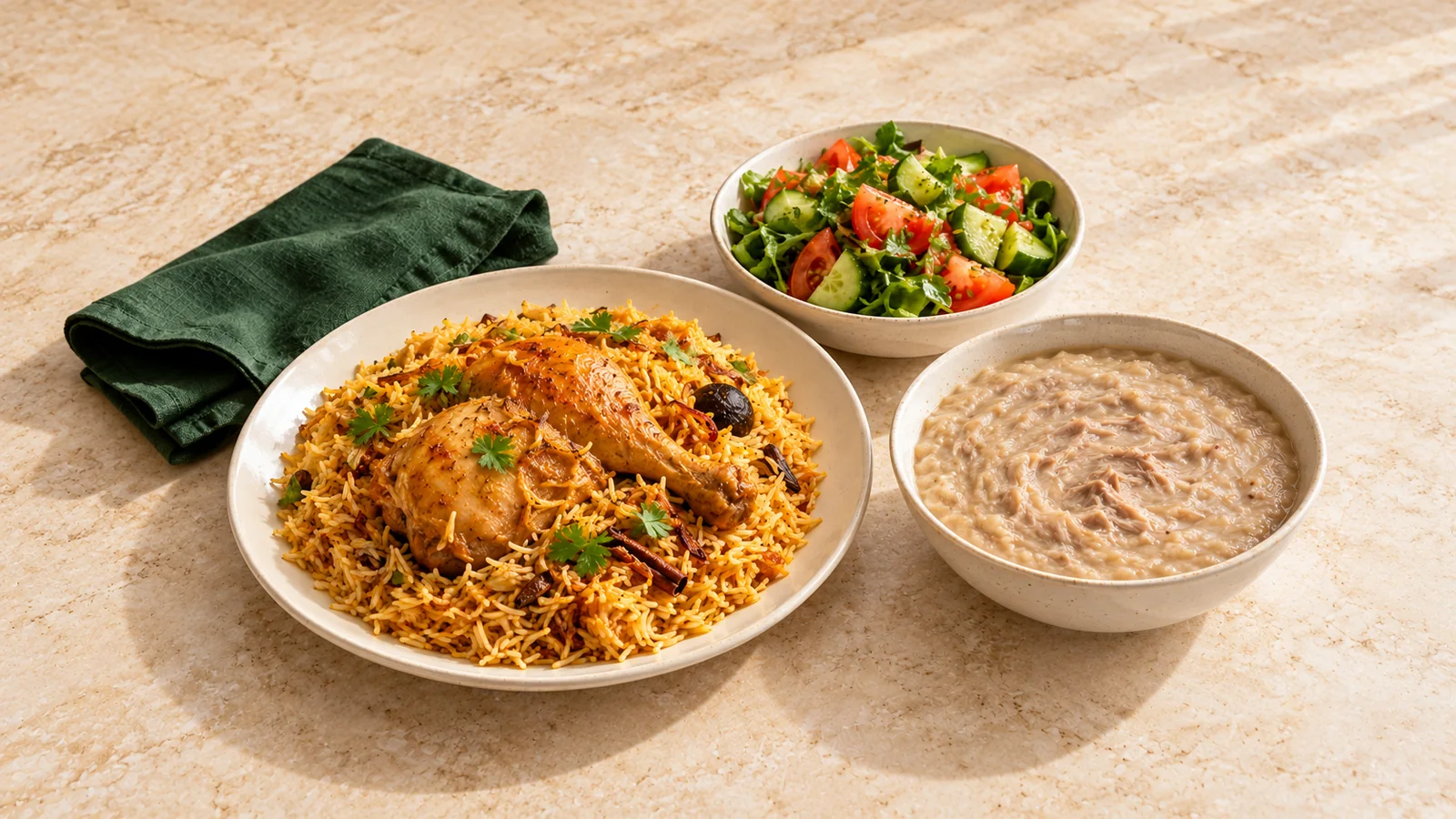
Imagine a family lunch in Abu Dhabi. A dish of machboos reaches the table, someone passes the salad, and conversation continues as everyone helps themselves. Before you have finished, a relative offers you more rice.
You want to enjoy the food and the company, but you are also trying to eat in a way that supports your health. What does a balanced meal look like at this table? The answer starts with how you combine familiar foods, what you serve alongside them, and how much you choose to eat.
Understand what balance adds to your meal
A varied eating pattern helps provide the nutrients your body needs. Rice and wheat supply carbohydrates for energy; meat, chicken, fish and pulses contribute protein. Vegetables, fruit and whole grains help provide fiber, vitamins and minerals. Balance involves the combination, variety and amounts of foods you eat over time. [1]
For many adults, a useful visual guide is roughly half the meal as vegetables and fruit, a quarter as grains, preferably whole grains, and a quarter as protein foods. These are approximate proportions, not a fixed serving prescription. [2] At lunch, that could mean a generous vegetable side with rice and chicken, with fruit at another point in the meal. A shared platter or bowl can still fit this approach.
Build a complete meal around machboos
With chicken machboos, look at the accompaniments before filling your plate. Set out cucumber and tomato salad or cooked vegetables where everyone can reach them. Serve some chicken and rice while leaving room for the vegetables. This is a practical way to apply the visual guide to a meal the family already enjoys.
If you usually cover your plate with rice, try serving a little less and adding a vegetable side you like. If salad does not appeal to you, consider cooked carrots, zucchini or green beans. Choose an option that fits the meal and your household's preferences. You do not need a special recipe or a separate menu.
When eating from a shared dish, take a moment to notice your own serving. Before accepting more, consider whether you are still hungry. If you have had enough, a warm thank-you and a compliment about the food can acknowledge the host's generosity. You can stay involved in the conversation after finishing your meal.
Think about what accompanies harees
Harees brings wheat and meat together in one dish, often finished with ghee. [3] Because the ingredients are mixed, dividing them into separate sections on a plate is not especially useful. Instead, consider the whole meal: the serving of harees, what accompanies it, and any extra ghee added at the table.
For example, serve harees alongside a cucumber and tomato salad or a small dish of cooked vegetables. Its meat already contributes protein, so another meat dish is not automatically needed. Recipes differ, and the proportions of wheat, meat and fat will affect what each serving provides. The appearance of the harees alone cannot tell you its nutritional content or the amount that suits you.
If you prepare harees at home, consider offering additional ghee separately. This lets each person decide whether to add any, while keeping the dish familiar.
Keep familiar flavors when adjusting the recipe
Ghee and butter contribute saturated fat. Using less, and replacing some with an unsaturated oil where suitable, can reduce the saturated fat in a meal. Choosing leaner meat or removing chicken skin is another option. [1,4] Start with one adjustment that works for the recipe rather than changing everything at once.
Salt also deserves attention during preparation. Check the sodium on stock-cube and ready-made sauce labels, and taste before adding more salt. Try building flavor with onion, garlic, spices, lemon or dried lime. [1,5] Discuss an adjustment with whoever usually cooks, so the family can try it together and decide what tastes right.
Use the same approach on a busy day
After a busy working day in Mohammed Bin Zayed City, takeaway may be the practical choice. If you order machboos, check whether vegetables are included and add a side if needed. If the rice serving is larger than you want, share it or request a smaller portion when available. Ask for sauces separately so you can choose how much to use. [5]
Consider the drink, too. Water is a straightforward everyday option; having it instead of a sweetened drink reduces the sugar added to that meal. [1] A useful routine is to pause before ordering and check the whole meal, including its sides and drink. Keep the decision simple enough to repeat on another busy evening.
Know when individual guidance will help
If you have diabetes, ask your treating clinician or a licensed dietitian how familiar meals can fit your personal plan. The amount and timing of carbohydrate may need to match your medicines and routine. [6] Bring an example of your usual meal, including drinks, sides and approximate servings. This gives the discussion a practical starting point. If you already follow a prescribed eating plan, use it to guide changes rather than replacing it with a general plate illustration.
At your next machboos meal, choose one vegetable side you enjoy and put it on the table before serving the rice. Make it easy to include from the start. Try that same adjustment the next time the family has machboos, and see how comfortably it fits your usual routine.
References
- World Health Organization. Healthy diet. Updated January 26, 2026. Accessed October 15, 2026.
- Harvard T H Chan School of Public Health, The Nutrition Source. Healthy Eating Plate. Last reviewed January 2023. Accessed October 15, 2026.
- Emirates News Agency WAM. Harees inscribed on UNESCO Representative List of Intangible Cultural Heritage. Published December 20, 2023. Accessed October 15, 2026.
- American Heart Association. Saturated Fats. Last reviewed August 23, 2024. Accessed October 15, 2026.
- American Heart Association. How to Reduce Sodium in Your Diet. Last reviewed January 5, 2024. Accessed October 15, 2026.
- National Institute of Diabetes and Digestive and Kidney Diseases, NIH. Healthy Living with Diabetes. Last reviewed October 2023. Accessed October 15, 2026.
Source notes
The plate proportions in [2] are an approximate guide for adults, not fixed gram portions. The machboos and harees examples are practical illustrations; nutrient values have not been calculated for a standardized recipe. Reference [3] supports the description of harees ingredients, not a health claim. Reference [6] supports individualized planning for people with diabetes.